Introduction
Historical clarity is not an academic luxury—it is a political necessity. The characterization of Ethiopia's military dictatorship from 1974 to 1991 as 'communist' or 'Marxist-Leninist' persists across political discourse, weaponized by reactionaries to discredit socialism and by confused leftists to defend the indefensible. This confusion must be dispelled through rigorous materialist analysis.
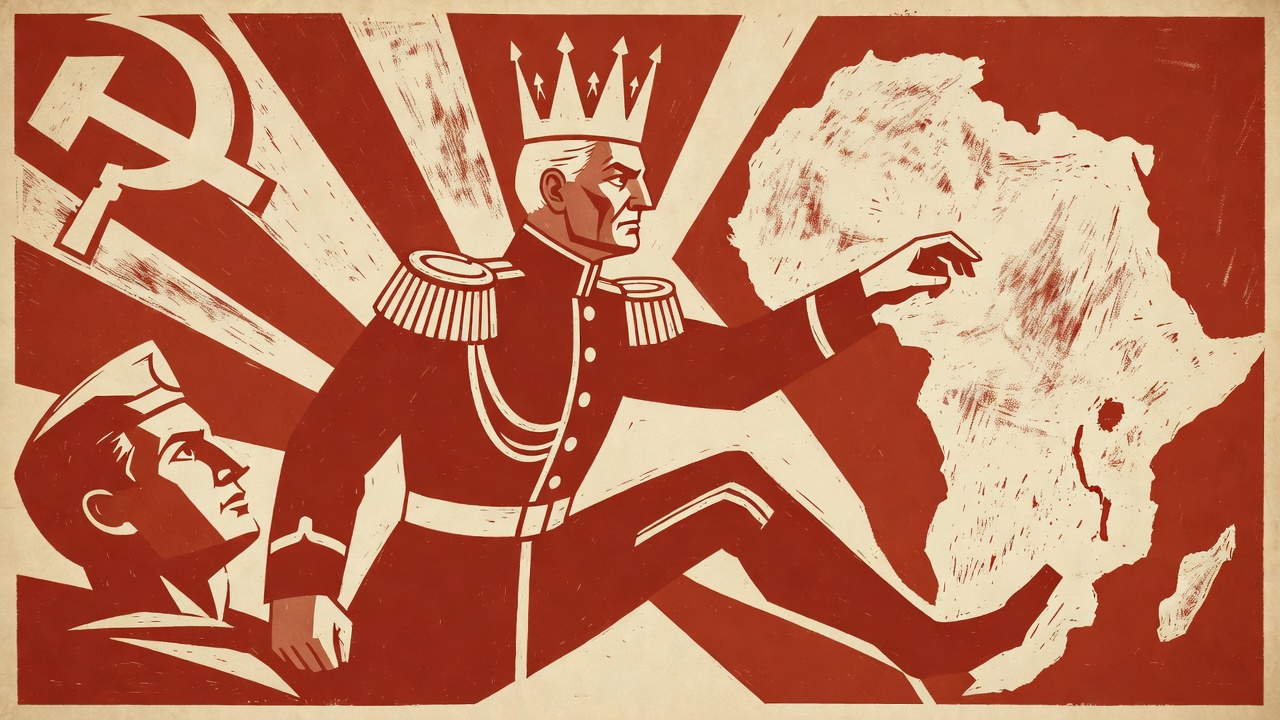
The Provisional Military Administrative Council, known as the DERG (Amharic for 'committee'), seized state power on September 12, 1974, overthrowing Emperor Haile Selassie. While the regime adopted Marxist-Leninist rhetoric in 1975, established a 'vanguard party' in 1984, and proclaimed the People's Democratic Republic of Ethiopia in 1987, these formal trappings obscured a fundamental reality: the DERG was a military junta that consolidated power through Bonapartist methods, not a workers' state governed by proletarian class power.
This article demonstrates that the DERG's structural character, class composition, and political trajectory corresponded not to Marxism-Leninism but to what classical Marxist theory identifies as Bonapartism—a military-police dictatorship that raises itself above society by exploiting class antagonisms while serving the interests of property owners. Understanding this distinction is essential for rebuilding authentic socialist politics in Ethiopia.
What Marxism-Leninism Requires
Marxist-Leninist theory establishes specific structural requirements for a workers' state. These are not arbitrary labels but descriptions of class power relations. A genuine socialist state requires three interconnected elements: a revolutionary party rooted in the working class, proletarian leadership of state institutions, and mechanisms of workers' power that enable the masses to exercise genuine political control.
First, the vanguard party must emerge organically from working-class struggle, not be imposed from above by military officers. Lenin's conception of the party presumed it would be composed of 'professional revolutionaries' drawn from advanced sections of the proletariat, not career military men preserving institutional privilege. The party's authority derives from its connection to mass movements, tested through years of political work among workers and peasants.
Second, state power must rest in working-class institutions—soviets, workers' councils, factory committees—that exercise direct control over production and administration. The dictatorship of the proletariat is not mere rhetoric but a concrete reorganization of state power that suppresses the bourgeoisie while enabling workers to govern.
Third, the transition to socialism requires the conscious activity of the working class itself, not bureaucratic decree. As Marx emphasized, the emancipation of the working class must be the act of the working class itself. Nationalization of property by military officers, however progressive in form, does not constitute workers' power if the working class lacks mechanisms to control those nationalized assets.
What the DERG Actually Was
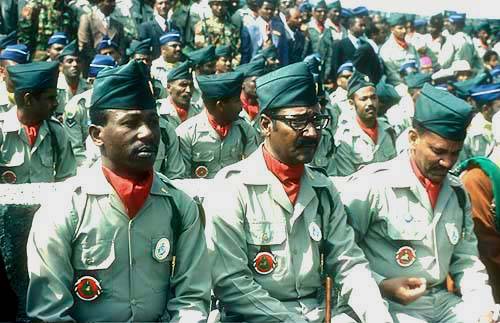
The DERG's origins reveal its class character. It emerged not from working-class organization but from mutinies by junior military officers protesting poor conditions in early 1974. These officers formed a coordinating committee of approximately 120 members, selecting Mengistu Haile Mariam as chairman. The initial composition was explicitly military: low-ranking officers and enlisted men from the Ethiopian Army who collectively seized power during nationwide unrest.
The DERG's relationship to civilian Marxist organizations demonstrates its Bonapartist character. Ethiopia possessed genuine Marxist parties in the 1970s: the Ethiopian People's Revolutionary Party (EPRP) and the All-Ethiopia Socialist Movement (MEISON), both emerging from the student movement and claiming working-class leadership. The DERG did not collaborate with these organizations as equals but systematically destroyed them. During the Red Terror of 1977-1978, Mengistu's forces killed tens of thousands of EPRP members and sympathizers, then turned on MEISON when it proved insufficiently subservient. The regime armed neighborhood associations (kebeles) with 20,000 guns to eliminate 'counter-revolutionaries'—a term applied to actual Marxists who challenged military rule.
The formation of the Workers' Party of Ethiopia (WPE) in 1984 exemplifies bureaucratic mimicry rather than genuine party-building. The WPE's Central Committee consisted of 123 members, 79 of whom were military or police officers. At least 20 DERG members sat on this Central Committee. The Executive Committee's seven members were identical to the DERG's own Standing Committee. Military personnel represented over 50 percent of the congress that established this supposed 'vanguard party.' As one analysis noted, 'Loyalty to the DERG was preferred over dedication to Marxism-Leninism or certain ideological ideals in considerations for party membership.'
The WPE Political Bureau functioned as Mengistu's personal instrument. One observer noted that 'General Secretary Mengistu's wishes generally prevailed, no matter what the opposition,' and that other members' influence derived 'more to their closeness to Mengistu than to any formal positions they might occupy.' This is the antithesis of democratic centralism—it is personalist dictatorship with vanguard party aesthetics.
The absence of workers' power is equally stark. The DERG did implement land reform, nationalizing rural land in 1975 and distributing it to peasants—a progressive measure by any standard. Yet workers in factories found their demands for shop-floor control systematically repelled. By mid-1975, strikes had been made illegal. The regime established state farms and cooperatives that, by 1980, produced only 6 percent of agricultural output and 20 percent of marketed production, indicating peasant resistance to collectivization imposed from above. Peasants' associations and kebeles were organized not as organs of workers' power but as instruments of state control, implementing DERG directives rather than expressing mass initiative.
This pattern corresponds precisely to what Marxist theory identifies as Bonapartism. As Trotsky wrote, Bonapartism emerges when 'the struggle of two social strata—the haves and the have-nots, the exploiter and the exploited—reaches its highest tension,' creating conditions for 'the domination of bureaucracy, police, soldiery.' Marx described such regimes as states where 'the sword rules without shame and club law prevails,' where the state apparatus 'assumes a certain independence of all the classes' while remaining fundamentally an instrument of property owners. The DERG fit this description exactly: a military-police apparatus that raised itself above society, crushed both feudal remnants and working-class organizations, and implemented reforms that served ultimately to stabilize capitalist development under bureaucratic management.
Why the Confusion Persists
Multiple factors sustain the mischaracterization of the DERG as communist. Cold War propaganda played an obvious role. The Soviet Union provided approximately one billion dollars annually in aid to Ethiopia after 1977, when Mengistu expelled American advisers and aligned with Moscow. This geopolitical alignment allowed Western commentators to classify Ethiopia as part of the 'communist bloc' regardless of its internal class dynamics. The Reagan administration's support for Ethiopian rebels was justified through anti-communist rhetoric, cementing in popular consciousness an equation between Soviet backing and socialist transformation.
The regime's own self-presentation contributed substantially. Mengistu's adoption of Marxist-Leninist language after 1977 was calculated to secure Soviet aid, not to implement scientific socialism. The 1987 constitution declared the WPE to be 'the formulator of the country's development process and the leading force of the state and in society,' echoing Soviet constitutional provisions. The proclamation of the People's Democratic Republic of Ethiopia created the appearance of civilianization while Mengistu and surviving DERG members continued to dominate. This was revolution from above, bureaucratic socialism as spectacle.
For the ruling class internationally, conflating the DERG with communism serves ideological purposes. If Ethiopia's mass killings, famines, and repression can be attributed to 'Marxism,' then socialism itself stands discredited. The Red Terror claimed between 30,000 and 750,000 lives; the 1984-1985 famine killed 600,000 to one million people, exacerbated by forced collectivization and military campaigns. Blaming these horrors on communist ideology rather than military dictatorship obscures the difference between workers' power and bureaucratic terror.
Some on the left perpetuate confusion through uncritical solidarity with anti-imperialist regimes. The logic runs: the DERG opposed Western imperialism, received Soviet support, and nationalized property, therefore it must be defended as socialist. This substitutes geopolitical alignment for class analysis. Anti-imperialism is necessary but insufficient; a regime can oppose one imperialist power while building bureaucratic state capitalism that crushes workers' organizations. Defending such regimes as 'existing socialism' only validates ruling-class propaganda and demoralizes the working class.
Implications for Today
Ethiopia's current political configuration bears the scars of the DERG period. The Ethiopian People's Revolutionary Democratic Front (EPRDF), which overthrew Mengistu in 1991, itself emerged from ethnic-based armed movements fighting the military dictatorship. The subsequent government institutionalized ethnic federalism, a response to both imperial centralization and DERG oppression. Contemporary Ethiopian politics remain structured by conflicts the DERG exacerbated through forced resettlement, villagization programs, and brutal suppression of regional autonomy movements.
For Ethiopian socialists, clarity about the DERG's character is essential. A genuine workers' movement cannot build on false foundations. Defending or romanticizing the DERG alienates workers who experienced its terror directly. Many Ethiopian workers and peasants correctly identify the DERG period as one of military dictatorship, not socialist transformation. Any socialist movement that claims continuity with the DERG sacrifices credibility among the masses.
The positive lesson is equally clear: Ethiopia possessed genuine Marxist organizations in the 1970s. The EPRP and MEISON, whatever their tactical errors, emerged from student radicalization and attempted to build working-class parties. Their destruction by the DERG demonstrates that military juntas are not allies of the working class, regardless of their rhetoric. Future socialist organizing must learn from this: workers' power cannot be delegated to military officers who promise to rule on behalf of the masses.
Internationally, the DERG experience offers warnings about bureaucratic deformation. Soviet support for the DERG, while motivated by geopolitical competition with American imperialism, represented the degeneration of internationalism into great power politics. Genuine proletarian internationalism would have supported Ethiopian workers' organizations against military dictatorship, not armed the dictatorship itself. The Soviet bureaucracy's inability to distinguish between workers' states and anti-Western autocracies reflected its own Bonapartist character by the 1970s.
Conclusion
The DERG was not communist. It was a military junta that exploited revolutionary upheaval to consolidate power, adopted Marxist-Leninist rhetoric to secure Soviet aid, and implemented reforms that strengthened state control while crushing working-class organizations. Its structural character corresponded to Bonapartism: a military-police dictatorship balancing between classes while serving ultimately to stabilize property relations under new management.
This assessment is not historical pedantry. The persistence of Cold War categories—labeling any Soviet-aligned regime 'communist'—prevents understanding of actual class dynamics. It allows the ruling class to discredit socialism by pointing to the DERG's crimes while obscuring the fact that those crimes resulted from military dictatorship, not workers' power. It confuses leftists into defending regimes that murdered Marxists and suppressed workers' organizations.
Clearing the historical record is a precondition for rebuilding class politics in Ethiopia and internationally. Ethiopian workers and peasants deserve a socialist movement that acknowledges the DERG's crimes, honors the memory of murdered comrades from the EPRP and MEISON, and builds workers' power from below rather than expecting deliverance from military officers. This requires theoretical clarity about what socialism is: not state ownership under bureaucratic management, but workers' control of production, proletarian democracy, and the conscious self-activity of the working class.
The lesson for contemporary struggle is unambiguous. Military juntas that adopt socialist rhetoric while crushing workers' organizations are not allies of the working class. Regimes that receive Soviet aid while imprisoning Marxists are not socialist states. Workers' power cannot be delegated to a bureaucracy or a military committee—it must be exercised directly through democratic institutions controlled by the masses themselves. Only by maintaining these distinctions can socialists avoid the errors that allowed military dictatorship to parade as communist revolution.
Socialism in Ethiopia must be rebuilt on correct foundations: workers' councils, not military committees; mass democratic participation, not bureaucratic decree; international working-class solidarity, not geopolitical opportunism. The DERG's legacy is a warning, not a model. Recognizing this truth honors the tens of thousands who died opposing military dictatorship and clears ground for authentic socialist politics.
Sources & References
Embedded Links
- No embedded links in this article
References
- [1] Encyclopedia Britannica: Ethiopia: Socialist Ethiopia (1974-91)
By Britannica
Published: 1999
Publisher: Encyclopedia Britannica
- [2] Revolutionary Ethiopia: From Empire to People's Republic
By Edmond J. Keller
Published: 1989
Publisher: Indiana University Press
- [3] The Eighteenth Brumaire of Louis Bonaparte
By Karl Marx
Published: 1852
- [4] Building Ethiopia's Revolutionary Party
By Middle East Research and Information Project
Published: 1982
Publisher: MERIP Reports, No. 106
- [5] German Bonapartism
By Leon Trotsky
Published: 1932
- [6] Bonapartism and Fascism
By Leon Trotsky
Published: 1934